
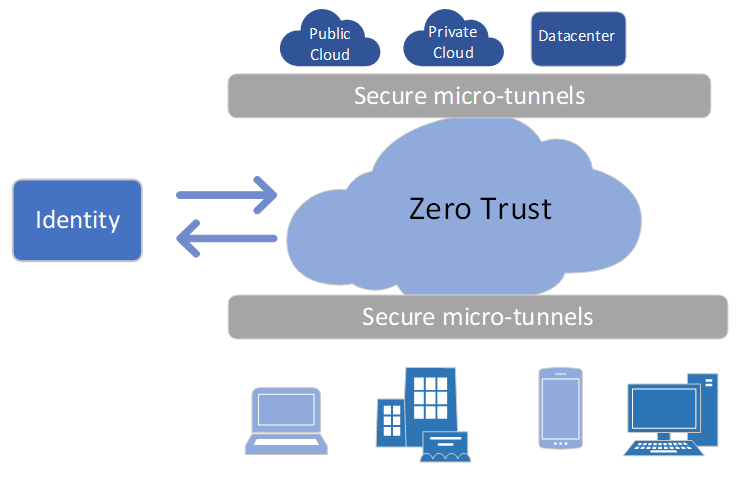
For more than two decades, the virtual private network has been the default answer to a simple problem: how does a remote user reach applications that live inside the corporate network? VPNs solved that problem reasonably well in an era when most applications lived in a single data center and remote access was the exception rather than the norm. That era is over. Applications are now distributed across cloud platforms, software-as-a-service tools, and on-premises infrastructure simultaneously, and the workforce accessing them is permanently distributed as well.
Zero trust network access controls have emerged as the architecture built for this reality. Rather than extending a trusted network perimeter outward to remote users the way a VPN does, it grants access to specific applications based on continuously verified identity and context, with no assumption of trust based on network location. Understanding how this model works, and why it represents such a significant departure from the VPN approach, is essential for any organization rethinking how it secures remote access to its applications.
Where the VPN Model Breaks Down
A VPN works by creating an encrypted tunnel between a remote device and the corporate network. Once that tunnel is established and the user authenticates, they typically gain broad access to whatever the network would otherwise expose them to, often well beyond the specific application they actually needed to reach.
This design creates two persistent problems. The first is the scope of access granted after authentication. A compromised VPN credential does not just expose one application. It can expose an entire network segment, enabling an attacker to move laterally and discover additional systems to target. The second problem is operational. VPN concentrators are internet-facing by design, making them a consistently attractive target, and patching, scaling, and managing them across a growing remote workforce add substantial overhead for IT teams.
Multi-agency modern network access guidance addresses this directly by outlining the vulnerabilities and business risks associated with traditional remote access and VPN deployments, and urging organizations to move toward more robust models such as zero trust and the Secure Access Service Edge. The recommendation reflects a broader consensus among security agencies that legacy remote access architecture is no longer adequate for the threat landscape organizations now face.
What Makes Zero Trust Network Access Different
Zero trust network access replaces the all-or-nothing access model of a VPN with a default-to-deny posture. No connection is trusted simply because it has been authenticated. Instead, access is granted only to the specific applications a user is authorized to reach, and that access decision is evaluated continuously rather than once at the start of a session.
This works through a broker model. When a user requests access to an application, the request is routed through a policy engine that evaluates identity, device posture, location, and other contextual signals before deciding whether to grant access. Crucially, the user is never placed directly on the network. The connection is brokered between the user and the specific application, which means the user has no visibility into, and no path toward, any other resource on the network.
For a comprehensive technical reference on this architecture and the standards underlying it, the NIST zero trust framework lays out the core principles that define zero trust as a security model, including the assumption that no implicit trust should be granted based on physical or network location, and that authentication and authorization must be evaluated as discrete functions before any session is established.
Application Invisibility and Reduced Attack Surface
One of the most significant security benefits of zero trust network access is that it removes applications from public visibility entirely. In a traditional remote access model, the VPN gateway itself is exposed to the internet, and the broader network is reachable once a connection is authenticated. With zero trust network access, applications are never exposed directly to the internet, and unauthorized users have no way to even discover that they exist, since there is no broad network path connecting them.
This concept, sometimes referred to as a dark cloud or invisible infrastructure, dramatically reduces the attack surface available to an external threat actor. There is no network segment to scan, no open port to probe, and no lateral path to traverse, because the architecture was never designed to expose those things in the first place.
Continuous Verification Instead of One-Time Authentication
A defining characteristic of zero trust network access is that trust is never treated as a static, one-time decision. Traditional remote access models authenticate a user once and then implicitly trust that user for the remainder of the session. Zero trust network access continuously evaluates session context, meaning that a change in device posture, an anomalous behavior pattern, or a shift in risk signals can trigger reauthentication or revoke access mid-session.
This is particularly important given how attackers have adapted their techniques. Credential theft and session hijacking have become common initial access methods, and a model that only verifies trust once at login is poorly equipped to detect or respond to a session that has been compromised after the fact. Continuous verification closes that gap by treating every request as an opportunity to reassess risk.
Application-Level Segmentation
Where a VPN typically grants access at the network layer, zero trust network access operates at the application layer. This distinction has significant implications for how organizations think about segmentation. Rather than creating broad network zones and hoping that firewall rules adequately separate sensitive resources from less sensitive ones, zero trust network access allows granular, per-application access policies to be defined and enforced directly.
This also simplifies the process of supporting third-party access. Contractors, vendors, and partners often need access to a narrow set of applications, and granting that access through a traditional VPN typically means exposing far more of the network than necessary. Application-level segmentation allows organizations to grant exactly the access required, with no additional exposure.
Migration Considerations
Most organizations do not replace their VPN infrastructure overnight. A phased migration typically begins with the applications or user groups facing the highest risk, such as third-party contractors or remote access to the most sensitive systems, before expanding zero trust network access coverage across the broader user base.
Throughout this transition, it is common for VPN and zero trust network access to coexist, with traffic gradually shifting toward the new model as confidence and coverage grow. The most successful migrations tend to treat this as an architectural shift rather than a simple product swap, since the value of zero trust network access depends heavily on consistent identity verification, well-defined access policies, and integration with the broader security stack rather than any single capability in isolation.
Frequently Asked Questions
Does zero trust network access completely eliminate the need for a VPN?
Not necessarily, and not immediately. Many organizations run zero trust network access and VPN in parallel during a transition period, gradually shifting application access to the new model while retaining VPN for specific legacy use cases that have not yet been migrated. Over time, most organizations aim to reduce VPN dependency significantly as zero trust network access coverage expands.
How does zero trust network access handle access for contractors and third parties?
Zero trust network access is particularly well suited to third-party access because it grants access at the application level rather than the network level. A contractor can be given access to exactly the applications they need without being placed on the broader network, which significantly reduces the risk associated with granting external parties remote access.
What happens if a device’s security posture changes during an active session?
Because zero trust network access evaluates trust continuously rather than once at login, a change in device posture, such as a failed compliance check or a newly detected vulnerability, can trigger a reevaluation of the session. Depending on policy configuration, this may result in additional authentication requirements or revocation of access until the device returns to a compliant state.