
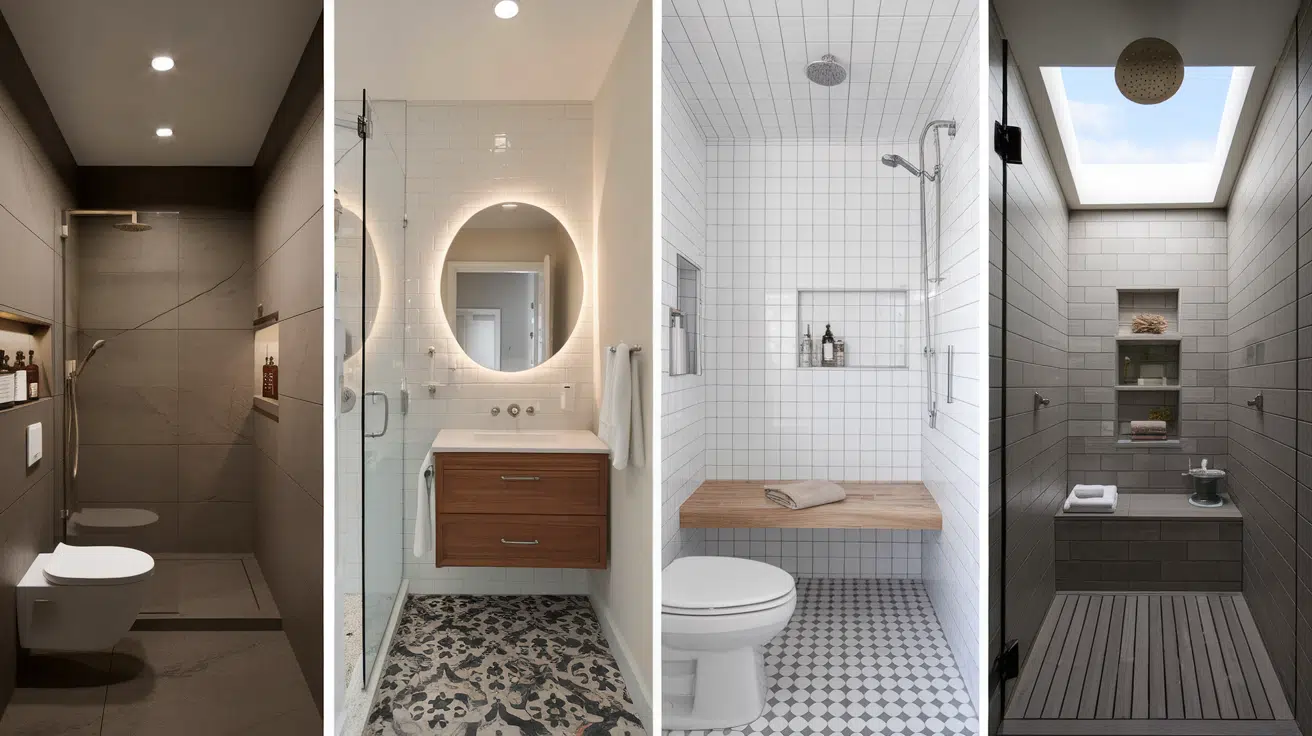
Britain has some of the smallest bathrooms in the developed world. Victorian terraces with a bathroom carved out of a back bedroom, post-war semis with a three-piece suite crammed into 40 square feet, new-build flats where the bathroom was clearly the last thing on the floor plan. If you have ever tried to towel-dry your back without knocking something off a shelf, you know the problem.
The good news is that small bathrooms respond extraordinarily well to design decisions – better, arguably, than large ones. In a big bathroom, choices are cosmetic. In a small one, the right choices genuinely change how the room functions.
Here is what actually works, ranked roughly by how much difference it makes relative to what it costs.
1. Get the Floor Clear
This is the single highest-impact principle in small bathroom design, and almost everything else follows from it. Visible floor reads as space. The more continuous floor you can see, the larger the room feels – regardless of actual dimensions.
Three moves deliver most of it:
- A wall-hung basin or floating vanity. Removing the pedestal or the plinth exposes floor underneath, and the effect is genuinely startling in a small room. Floating vanities also give you usable drawer storage, which pedestal basins do not.
- A wall-hung toilet with a concealed cistern. The cistern goes into a stud wall, the pan floats, and you gain both visual floor and easier cleaning. It costs more than a close-coupled unit because it requires framing, so it needs deciding before work starts.
- Run the same flooring throughout, including into the shower where possible. Every material transition creates a visual boundary that chops the room into smaller pieces.
2. Replace the Bath With a Walk-In Shower
Contentious, but for most households it is the right call in a genuinely small bathroom. A 1700mm bath consumes an enormous share of a small footprint, and the honest question is how often it gets used.
A walk-in shower in the same footprint feels dramatically more open, is easier to clean, and is far more accessible as you get older – which matters if you plan to stay in the house.
The caveat: keep a bath somewhere in the property if you can. Families with young children look for one, and a house with no bath at all narrows your buyer pool at resale. If it is your only bathroom and you have small children, a compact shower-over-bath arrangement may still be the sensible compromise.
3. Consider the Wet Room Properly
The wet room – where the whole floor is waterproofed and sloped, with a single glass screen or none at all – is one of the best answers to an awkward small space. No tray, no enclosure, no door swing to design around. It is particularly effective in rooms with sloping ceilings or odd angles, where a conventional enclosure simply will not sit sensibly.
What it genuinely requires, and where people get caught out:
- Full-room tanking, not just the shower zone
- Correct floor slope to the drain, built into the substrate
- Serious extraction. This is the one people underestimate most. A wet room creates a space that gets damp everywhere and dries slowly, and inadequate ventilation in that situation produces mould rather than character.
Get the ventilation right and a wet room is superb. Get it wrong and you have created a maintenance problem.
4. Tile to the Ceiling
Low cost, high impact. Stopping tile partway up the wall creates a horizontal line that visually lowers the ceiling and chops the room. Running it to the ceiling draws the eye up and makes the space read as taller and more considered.
It also removes the paint line that fails first in a humid room, which is a maintenance win as well as an aesthetic one.
5. Use Larger Tiles, Not Smaller Ones
The intuition is backwards here. People choose small mosaic tiles for small rooms, reasoning that scale should match. In practice, small tiles mean many grout lines, and grout lines create visual noise that makes a room feel busier and therefore smaller.
Large-format tiles with minimal grout lines produce a calmer, more continuous surface. Use the largest format your installer can lay flat – and note that large format demands a flatter substrate, so this is a labour-quality question as much as a material one.
6. Choose Clear Glass, and Less of It
A frameless clear glass screen is nearly invisible. Frosted glass, patterned glass, and framed enclosures all create a visual wall that divides the room in two.
If you can get away with a single fixed panel rather than a full enclosure with a door, do. No door means no swing to accommodate and nothing to collide with in a tight space. Just make sure the showerhead sprays away from the opening and the panel is long enough to contain overspray, otherwise you will be mopping daily.
7. Steal the Storage From the Walls
Small bathrooms fail on storage more often than on space. The fix is to stop placing storage in the room and start building it into the walls:
- A recessed mirrored cabinet flush with the wall, rather than a projecting one
- A tall vertical niche in the shower instead of hanging caddies – one tall niche holds more and looks more deliberate than two small ones
- A shallow full-height cupboard in a stud wall
- Drawers rather than doors in a vanity, because you can see and reach everything
- The space above the door, which is dead in almost every bathroom and takes a shelf perfectly
8. Light It Properly, in Layers
A single ceiling pendant in the middle of the room is the default and the worst option. It casts shadows, makes the room feel like a box, and is unflattering at the mirror.
Better:
- A wet-rated recessed light inside the shower, so the shower is not the dark corner
- Vertical light at the mirror – either side rather than overhead
- Warm colour temperature, around 2700–3000K. Cool white makes tile look clinical and skin look grey.
- A strip light under a floating vanity or in a niche. Inexpensive, and it makes the room look considerably more expensive than it was.
- Maximise natural light. If privacy is the concern, obscured glazing in the lower pane or a top-hung window beats frosting the whole thing.
9. Reduce the Number of Visual Objects
Small rooms are ruined by clutter more than by dimensions. A large mirror, ideally wall-to-wall, doubles the perceived space and is the cheapest trick available. Beyond that: fewer, larger objects rather than many small ones. Matching hardware finishes. Recessed rather than surface-mounted fittings. Concealed cistern rather than exposed. One material palette rather than three.
The goal is fewer edges for the eye to catch on.
10. What Humid Climates Teach About Small Bathrooms
It is worth looking at how small bathrooms are built in places where humidity is a year-round design constraint rather than a winter inconvenience – coastal Florida being an obvious example. Bathrooms there face constant high ambient humidity, salt air, and heavy mould pressure, and the design responses are instructive for anyone dealing with a small, poorly ventilated British bathroom.
The consistent themes: extraction specified well above the minimum requirement rather than at it; porcelain rather than natural stone in wet zones; mould-resistant substrate as standard; high-performance or epoxy grout; moisture-stable vanity materials rather than untreated timber; and open glazing that promotes airflow rather than trapping damp air in a sealed enclosure.
That last point is the one most relevant to UK homes. A tightly sealed shower cubicle in a room with a weak extractor fan is a mould generator. The small-bathroom approaches used in Florida homes are worth a look precisely because they are designed around moisture management first and appearance second – which is exactly the right order of priority for a small British bathroom, and exactly the order most renovations get backwards.
The Things Not to Compromise On
Whatever you do with the design, three items determine whether the room is still good in ten years, and all three are invisible:
- Proper tanking. A complete, correctly lapped waterproofing system, installed as a system rather than improvised from silicone and optimism. This is where cheap bathroom refits fail, and the failure is expensive because it means starting again.
- Correct slope to the drain, verified with a level.
- Extraction sized for the room, running long enough after use to actually dry it – a humidity-sensing or timed unit rather than one wired to the light switch.
If a quote comes in noticeably below the others, it is almost always one of those three that got thinned out. They are the least visible items on the job and the only ones that determine longevity.
The Short Version
A small bathroom is not a design problem to be solved by clever products. It is a spatial problem solved mostly by clearing the floor, reducing visual interruptions, building storage into the walls, and lighting it in layers. Do those four things and a 40-square-foot bathroom will feel like a considered room rather than a compromise.
Then spend the rest of the budget below the surface, on the waterproofing and the ventilation that nobody sees. Whether you are working with a local fitter or a general contractor on a larger project, the quality of that hidden work is what separates a bathroom you enjoy for fifteen years from one you rip out in six.
Small does not have to mean cramped. It usually just means every decision matters more.