
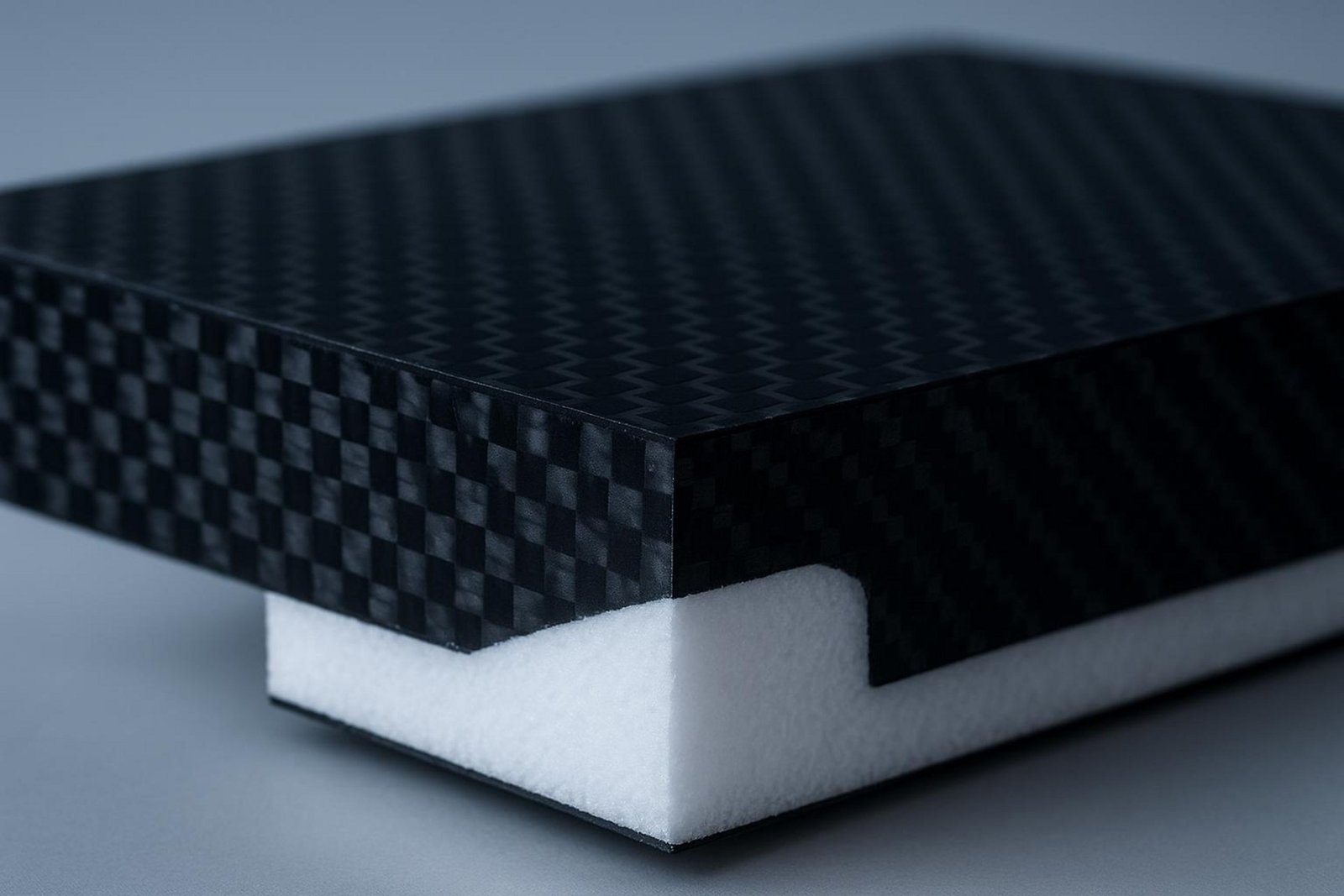
For engineers working with advanced materials, it helps to know how high-performance foams behave and where they fit best. In jobs where low weight, high strength, and heat resistance matter, Rohacell foam is often a leading choice. Rohacell is a rigid, closed-cell polymethacrylimide (PMI) foam. It combines strong mechanical performance, high heat resistance, and very good compression creep strength. Because of this mix, engineers can build lighter parts and still meet strength and temperature targets-often in ways that standard materials cannot-across fields like aerospace, automotive, and medical tech.
It stands out because it can stay strong at low density, and it keeps its shape under long loads and higher temperatures. It is more than a basic foam insulation product; it is a structural core material that many composite designers use as a reference point.
What Is Rohacell Foam and Why Does It Matter for Engineers?
What Is the Chemistry Behind Rohacell Foam?
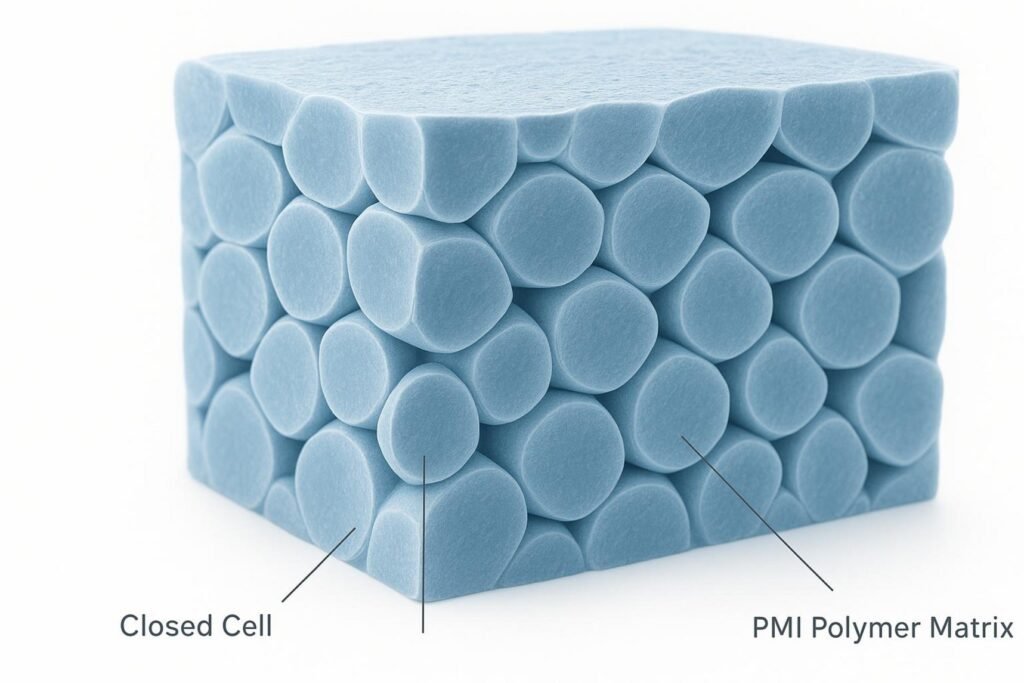
Rohacell foam is based on polymethacrylimide (PMI) chemistry. PMI is a polymer family made to form rigid, closed-cell foams. This chemical structure is what gives Rohacell its well-known performance. It can keep its strength and shape even when produced at very low densities. Tight control of the recipe and the manufacturing steps leads to a strong strength-to-weight ratio compared with many other structural foams.
This PMI chemistry also helps it resist many environmental effects, including many solvents. It also supports strong heat resistance, which is why Rohacell can be used in processing and service conditions that would damage lower-grade foams.
Key Properties That Distinguish Rohacell
Rohacell’s main traits come from PMI and controlled manufacturing. Engineers value its high heat resistance, which lets it handle higher processing and use temperatures without breaking down. Its high compression creep strength is also important because it helps the core keep its thickness and shape under constant load.
Other key points include:
- High strength at low density: good specific strength.
- 100% closed-cell structure: reduces resin soak during composite processing, helping control part weight.
- Isotropic behavior: properties are similar in all directions, which makes design and calculations easier.
How Is Rohacell Different from Other Structural Foams?
Compared with other rigid foams and core materials like honeycomb, Rohacell fills a specific gap. Many foams can lower weight or add insulation, but Rohacell combines heat resistance, creep resistance, and fatigue capability at a level that many alternatives cannot match.
For example, a Rohacell 51 IG-F grade (about 52 kg/m³) can reach mechanical properties that other foams may only reach at higher densities (often 75-80 kg/m³). Its PMI matrix also holds up well under repeated loading, helping reduce microcracks and slow loss of strength that can show up in some other cores. Some grades keep useful performance up to about 200°C, which gives engineers more room in design than common foam cores.
How Rohacell Foam’s Structure Drives Mechanical Performance
Role of Closed-Cell Structure in Strength and Insulation
Rohacell’s closed-cell structure is a major reason for its mechanical behavior. Each cell is separated by continuous polymer walls. Loads spread through the foam more evenly, which supports good strength and stiffness. During composite layup, the closed cells also limit resin absorption, avoiding extra weight and helping keep laminate quality consistent.
The closed-cell design also reduces moisture intake. Water enters mainly by diffusion, not by capillary action. This matters where water could reduce performance or cause damage during freeze-thaw cycles.
Density-Property Relationship and Specific Strength
Rohacell is sold in many densities, commonly from about 31 kg/m³ up to 200 kg/m³, with some special grades beyond that. This range lets engineers match the foam to the load case:
- Lower density: best for saving weight where loads are moderate.
- Higher density: better for heavier loads and higher stresses.
A key benefit is that Rohacell keeps strong properties even at low density. That means an engineer can often choose a lower-density Rohacell grade than a competing foam and still meet strength goals, cutting weight without losing structural performance.
Compressive Behavior Under Static and Dynamic Loads
Rohacell has compressive strength that places it among the stronger rigid foams. This matters in sandwich structures where the core must resist crushing. It also performs very well in compressive creep, keeping its shape during demanding curing conditions-for example, autoclave cycles up to about 180°C and 0.7 MPa (for certain grades). This resistance to slow deformation under load at high temperature is a major reason it is used in high-end composites.
Dynamic Strength and Fatigue Performance
For parts that see repeated loads (vibration, cycling, impacts over time), fatigue resistance is a must. Rohacell converts its good static strength into strong fatigue behavior. The PMI matrix helps limit cracking under cyclic stress, and the closed-cell structure helps spread loads so stresses do not concentrate as easily. This improves service life in dynamic conditions.
Creep Resistance and Long-Term Reliability
Creep resistance is one of Rohacell’s most important advantages. It helps composite parts keep their thickness, stiffness, and shape over long service times, even under steady loads and higher temperatures. This is important for parts that see constant stress or repeated heat cycles, where slow sagging can cause fit problems or failure. Some grades can be heat-treated to improve creep behavior even more, which expands the usable temperature and load range.
Temperature-Dependent Properties and Heat Resistance
Heat resistance is a core benefit of Rohacell. Many rigid foams soften a lot as temperature rises, but Rohacell keeps a large part of its room-temperature strength and stiffness over a wide range. Some grades can be processed up to about 220°C and can keep mechanical performance up to around 200°C in service. This high heat distortion level can also support faster-curing resin systems and shorter cure cycles, which can speed up production while keeping part quality.
Core Performance Characteristics Engineers Should Evaluate
Compression, Tensile, and Shear Strength
When choosing a foam core, engineers should check the basic mechanical numbers. For Rohacell, compressive strength often gets the most attention because it controls crushing resistance in sandwich panels. Tensile and shear strength also matter because they show how the foam behaves when pulled or when forces act along the surface.
These three properties work together and affect how the core resists deformation and keeps performance over time. This matters in areas like reusable packaging, industrial handling parts, and load-bearing structures.
Impact Resistance and Energy Absorption
Rohacell’s closed-cell structure supports good impact behavior and energy absorption. In uses such as automotive crash parts or protective industrial components, the ability to absorb and spread impact energy helps reduce damage to the core and to the composite skins. Because the internal structure is uniform, energy absorption tends to be predictable across the sheet or block.
Water Absorption, Chemical Resistance, and Flammability
The 100% closed-cell structure is helpful when moisture or chemicals are involved. Rohacell takes in very little water (mainly by diffusion), which helps avoid weight gain and loss of properties seen in open-cell or weaker foams. It also resists many common solvents.
For applications with strict fire rules (aerospace, rail), some grades such as ROHACELL® S are made for better fire behavior and can pass tough tests like the 60-second vertical burn test standard to FAR 25.853. While moisture uptake is usually low and reversible, heating above 100°C when moisture is present can create steam and may affect bonding to skins. Because of that, pre-drying or using heat-treated (HT) grades is often recommended.
Dimensional Stability Under Process and Service Conditions
Keeping tight dimensions matters from manufacturing through the full service life. Rohacell performs well under the higher temperatures and pressures used in composite curing. For certain grades, it can keep stable dimensions under autoclave conditions up to about 180°C and 0.7 MPa. This stability, along with strong creep resistance, helps parts hold their intended shape and performance for years.
One point to watch: heat treatment improves properties but can cause small, permanent changes in volume and surface area. That means forming steps should be done after heat treatment.
Comparing Rohacell Grades and Choosing the Right Foam
Available Rohacell Grades and Their Applications
Evonik offers many Rohacell grades aimed at different needs. The number in the grade (31, 51, 71, 110, 200, etc.) is the approximate density in kg/m³, which quickly shows the weight vs. strength trade.
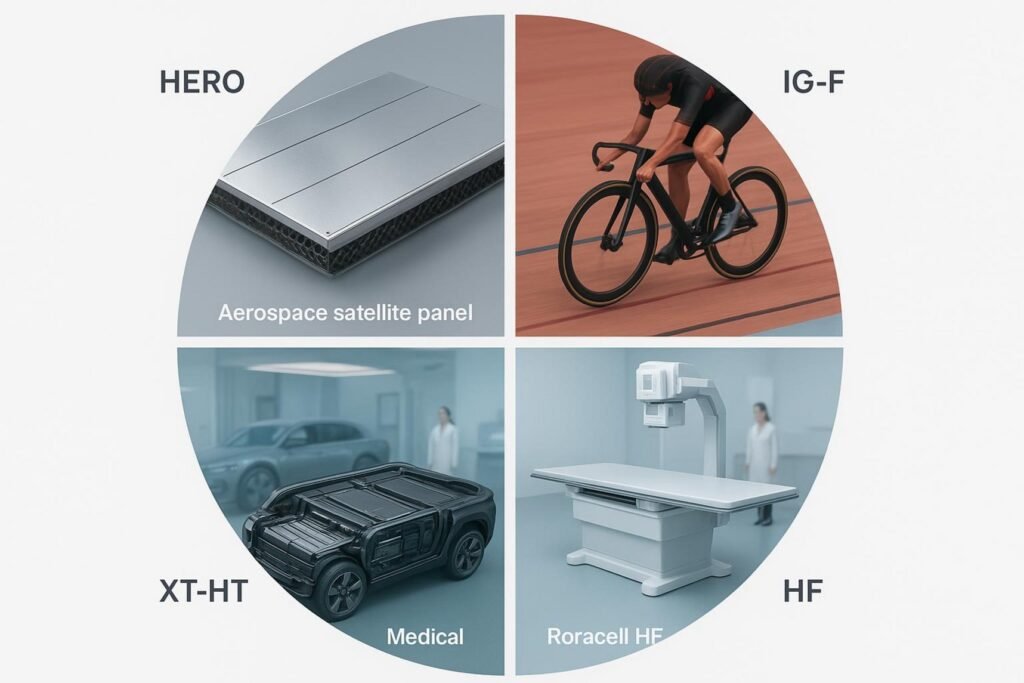
- ROHACELL® IG-F (31-110 kg/m³): Standard multi-purpose grade for industrial, medical, sport, automotive, and electronics. Max cure temperature 130°C. Known for stiffness and heat resistance.
- ROHACELL® A (31-71 kg/m³): Aerospace-qualified base grade for aircraft and space. Max cure temperature 130°C.
- ROHACELL® HE (51-200 kg/m³): Finer cells than IG-F and the highest elongation at break. Good for automotive, sport, marine, industrial. Not aerospace certified and not available heat-treated. Max cure temperature 130°C.
- ROHACELL® HERO (51-200 kg/m³): High-performance aerospace grade with higher temperature (180°C max cure) and compression resistance, plus the highest elongation at break. Always heat-treated.
- ROHACELL® WF / WF-HT (51-200 kg/m³): Aerospace-qualified with higher temperature and compression resistance than IG-F. WF for 130°C cure; WF-HT for 180°C. Used in aircraft, space, automotive, industrial, radomes (note: 71 WF and 110 WF are not certified for automotive/industrial).
- ROHACELL® RIMA / RIMA-HT (51-110 kg/m³): Fine cells, high temperature (130°C / 180°C) and compression resistance, made for low resin uptake (about 50 g/m²). Good for infusion in aerospace, automotive, sport.
- ROHACELL® RIST / RIST-HT (51-110 kg/m³): High temperature (130°C / 180°C) and compression resistance with medium cells. Used in aircraft, space, automotive, industrial.
- ROHACELL® XT / XT-HT (71-110 kg/m³): Highest temperature (180°C / 190°C) and compression resistance. After heat treatment, can handle up to 190°C and 0.7 MPa for very demanding aerospace and industrial use.
- ROHACELL® S (51-110 kg/m³): Better fire behavior (passes FAR 25.853). For aircraft, railway, shipbuilding. Max cure temperature 130°C.
- ROHACELL® HF (31-71 kg/m³): Fine cells plus high transparency and strong dielectric properties. Good for radomes, antennas, medical, electronics where low dielectric constant and loss matter. Max cure temperature 130°C.
- ROHACELL® EC / EC-HT (71-150 kg/m³): Highest electromagnetic absorption for “Stealth” use in aircraft, electronics, radomes. EC for 130°C cure; EC-HT for 180°C.
Comparison with Honeycomb and Other Foam Cores
Aluminum honeycomb and other polymer foams (like PVC or PET) can also reduce weight, but Rohacell is often used as a reference because of its overall mix of properties. Honeycomb can give very high stiffness-to-weight in certain directions, but it is usually anisotropic, can take in moisture if not sealed, and can be harder to shape into complex curves. Many standard rigid foams do not match Rohacell’s heat distortion temperature, creep resistance, or mechanical strength at the same density, which limits them for hot cure cycles or high-stress parts. Rohacell’s PMI structure helps cover the gap: isotropic behavior, good processing options, and strong heat and mechanical stability.
Factors Affecting Material Selection Across Industries
The best Rohacell grade depends on the job requirements. Engineers should weigh:
- Use temperature and cure process: match the foam’s max cure temperature (for example, 130°C IG-F, 180°C HERO, 190°C XT-HT) to the resin and process.
- Load level: higher density usually means higher compressive strength and better durability.
- Resin compatibility and resin uptake: fine-cell grades like RIMA help reduce resin soak, which is helpful in infusion where weight control is tight.
- Exposure conditions: moisture, chemicals, and fire needs (for example ROHACELL® S) can drive the choice.
- Special electrical needs: dielectric performance (ROHACELL® HF) or electromagnetic absorption (ROHACELL® EC) can be the main reason for selection.
- Machining and forming needs: CNC machining, thermoforming, and cold forming can matter as much as raw strength.
Cost Considerations and Lifecycle Value
Rohacell is a premium structural material, not a low-cost general foam, so price is higher. In sectors where performance and consistency matter most (aerospace, motorsport, high-end industrial), that cost can be worth it because of lifecycle value:
- Weight reduction: helps fuel burn in aircraft, range in EVs, and performance in sports gear.
- Better structural performance: strength, stiffness, and fatigue resistance support longer-lasting parts.
- Faster manufacturing options: high-temperature curing and advanced processes can shorten cycle time.
- Long service life: strong creep and heat resistance can reduce maintenance and extend use time.
Material Selection Strategies for Engineers
Balancing Mechanical Performance with Processability
Good results with Rohacell come from balancing structural targets with manufacturing limits. Since there are many grades, there is often a good match that meets strength needs while still working well with the chosen process. A foam chosen for autoclave curing may behave differently in vacuum infusion, so match the grade to the process (hand lay-up, RTM, filament winding, fiber placement).
Rohacell is also easy to machine: it can be milled, drilled, turned, sanded, and thermoformed with common tools. The closed cells limit resin flow into the core, which saves weight and can also help with vacuum fixation during machining for better accuracy.
Assessing Design Freedom and Fabrication Needs
Rohacell supports a lot of design flexibility. It becomes thermoelastic at about 175°C to 220°C (depending on grade and density), which allows hot forming of complex 3D shapes at good speed and cost. Cold forming can also reach tight tolerances, with bend radii as small as about twice the panel thickness. CNC machining adds even more options, including complex ready-to-bond cores.
During planning, decide what matters most:
| Fabrication method | Best for | Typical benefit |
| Hot forming | complex 3D shapes | fast shaping |
| Cold forming | tight tolerances | small bend radii |
| 4-/5-axis CNC | detailed geometry | ready-to-use cores |
Rohacell also bonds well with most common adhesives. Mechanical anchoring in cut cells can improve bond strength.
Meeting Industry Standards and Safety Requirements
In regulated industries, compliance matters as much as performance. Evonik’s Aerospace Quality Management System (certified to EN 9100:2018 / AS9100:2016) supports use in aerospace programs. Some grades, such as ROHACELL® S, are made to meet strict fire safety needs like FAR 25.853.
General safety points also apply. Rohacell foam is mostly physiologically inert, non-hazardous, and non-water-polluting. Still, machining can create fine plastic dust that may irritate, so good ventilation is needed. Processing with a heating wire is not recommended because it may create harmful gases, so special controls would be required.
Applications That Benefit Most from Rohacell Foam
Aerospace and Aircraft Structures
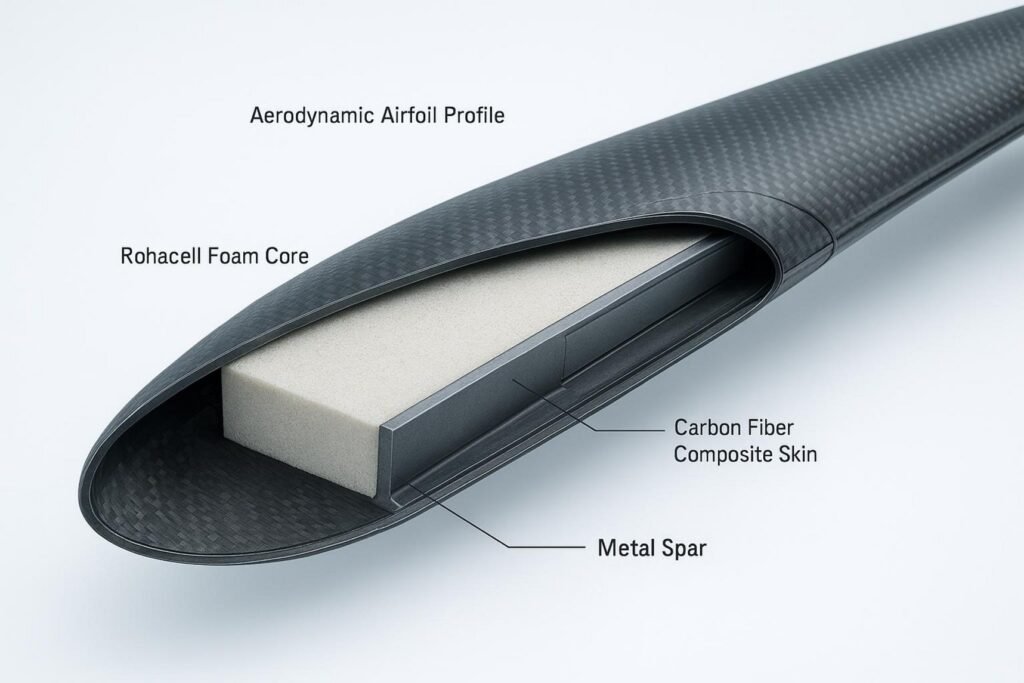
Aerospace was an early major use case for PMI foams. For more than 50 years, Rohacell has supported lightweight structures tied to fuel efficiency and performance. It is used in primary parts like pressure bulkhead stringers and floor panels, and in control surfaces where weight affects handling. Radomes use it because it can combine structural performance with electromagnetic transparency.
Helicopters also benefit: PMI foam cores allow blade designs that are hard to make with heavier materials, while creep resistance helps blades keep their shape over time. Grades like ROHACELL® WF are made to meet strict MIL and CMS specifications.
Automotive and Transportation Integration
The push for lighter vehicles has increased Rohacell use in automotive. It is used in crash structures where energy absorption supports the composite skins, and in underbody panels that need stiffness without extra mass. Its forming ability also supports semi-structural parts like interior trim and load floors.
EV growth has increased interest even more, especially for lightweight battery pack enclosures where range and heat performance matter. High-performance PMI grades can be used in structural battery housings to support crash protection and thermal management.
Sports and Leisure Equipment
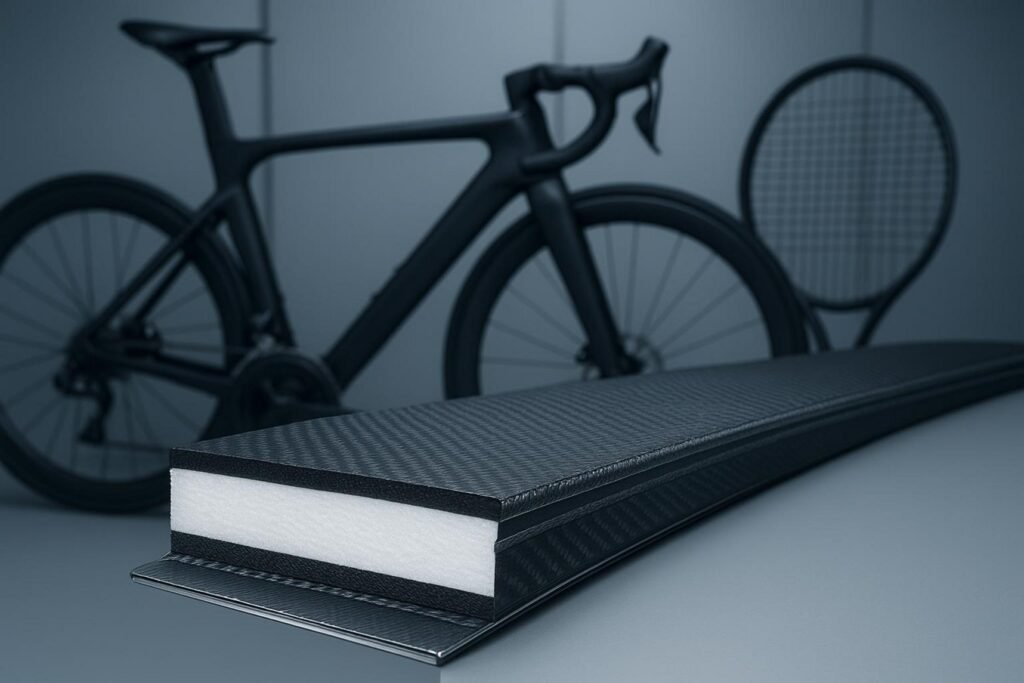
Sports equipment often adopts advanced materials early, and Rohacell fits well. In racing bikes, small weight savings can matter. Ski and snowboard cores use Rohacell for torsional stiffness and vibration damping, which improves control. Racquet frames can use it for better weight placement. In marine sports gear (racing sailboats, surfboards, kayaks), the low weight, stiffness, and moisture resistance of closed-cell foam help in harsh wet conditions.
Medical, Electronics, and Renewable Energy
Rohacell is also used in several high-tech areas:
- Medical imaging: X-ray tables use PMI foams because they have low density and low X-ray absorption while still carrying patient loads. Fine-cell grades help keep image quality high.
- Electronics and RF: PMI foam has good dielectric behavior for antennas and radomes. HF grades with low dielectric constant and low loss are used in satellite communications, radar, and 5G. Drones use PMI cores for light airframes, longer flight time, and better protection against vibration and impacts.
- Renewable energy: Wind turbine blades use large amounts of core material. As blades get larger, higher-performance PMI grades are used in key areas like blade roots and spar caps, where fatigue resistance and creep behavior support decades of service, including offshore use.
Recent Developments and Innovations in Rohacell Foams
What Does Rohacell HERO Offer?
Rohacell HERO is a newer high-performance option aimed at demanding aerospace structures. It offers higher temperature resistance and higher compression resistance than IG-F, and it has the highest elongation at break in the Rohacell family. HERO is always heat-treated, giving strong mechanical properties and a maximum curing temperature of 180°C. Its medium cell size helps balance strength and damage tolerance.
Specialized ROHACELL® suppliers such as Chem-Craft can advise on selecting the right grade for a specific aerospace application. One practical point: once HERO sheets or shapes are processed, they cannot be re-dried.
Latest Advancements for Aerospace and Automotive
The Rohacell family keeps growing based on industry needs. For aerospace, work has focused on higher temperature capability for tougher cure cycles, such as XT-HT grades that can handle up to about 190°C. Fine-cell options like RIMA aim to reduce resin uptake even more, which supports very light parts and efficient infusion.
In automotive, changes are driven by EV scale-up and the need for higher-volume production. This includes grades and formulations aimed at structural battery housings that must balance crash safety, thermal control, and low weight.
A Track Record of Adaptation and Future Prospects
Rohacell has a long history in lightweight structures, and its grade lineup has changed over time to match new targets. As industries keep pushing for better efficiency, performance, and sustainability, PMI foam technology continues to support designs that are hard to reach with standard materials-whether that means lighter aircraft, stronger wind blades, faster sports gear, or more capable medical devices. Continued research and development is likely to keep Rohacell as a key structural foam for many years.
Making the Right Material Choice for Your Engineering Project
Practical Advice for Selecting Rohacell Foam
Picking the right Rohacell grade works best with a clear step-by-step method:
- Define requirements: maximum service temperature, expected loads, and needed lifetime.
- List exposure conditions: moisture, chemicals, and fire requirements.
- Compare grades: density, cell size (coarse/medium/fine), and maximum curing temperature.
- Check special needs: dielectric properties for RF, fire behavior for aircraft/rail, low resin uptake for infusion.
- Match the manufacturing method: autoclave, vacuum infusion, thermoforming, RTM, and so on.
- Account for long-term behavior: creep resistance is often a deciding factor over the full service life.
The goal is not to pick the strongest or the lightest grade by default. The goal is to pick the grade that fits all constraints at once.
Common Challenges and How to Address Them
Even with a high-performance foam, some issues come up:
- Moisture before hot processing: small moisture pickup can affect creep or cause steam during high-temperature cure. Store material dry (diffusion-proof bags are best) and re-dry before processing above 100°C.
- Many grade options: it can be hard to pick the right one. Use technical data sheets and ask for guidance when needed.
- Higher material price: handle this with a cost vs. benefit review that includes weight savings, longer service life, process speed, and new design options.
When to Work with Material Experts
For high-risk, high-performance, or tightly regulated projects, working with material experts or experienced distributors can save time and reduce errors. They can help confirm the right grade, review processing limits, and suggest practical manufacturing steps. This support can be especially useful for aircraft parts, medical devices, and high-performance automotive components where a wrong material choice can cause major delays or costly redesigns.