
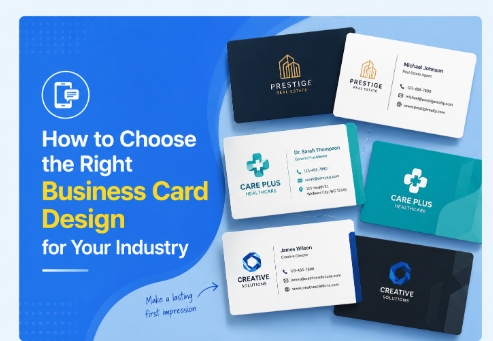
Most guides on this topic jump straight to a list of pretty templates. That’s useful for inspiration, but it skips the actual question business owners ask: how do I know which design is right for my industry, not just which one looks nice? Getting business card design by industry right comes down to matching your card to how your clients make decisions not copying whatever trend is popular this year.
This guide walks through the framework professionals use to choose a design that fits their field, before you even open a design tool.
Start With What Your Industry Signals to Clients
Every industry has an unspoken visual language. Clients form judgments about competence and trust within seconds, and your card either reinforces that judgment or quietly contradicts it.
- Finance, law, and consulting clients expect restraint. A cluttered or overly playful card can read as unprofessional, even if your work is excellent.
- Creative fields like photography, design, and marketing are judged the opposite way a plain, corporate-style card can make a creative professional look uninspired.
- Hospitality, retail, and wellness brands tend to benefit from warmth: softer colors, friendlier type, and sometimes a personal photo.
- Construction, manufacturing, and technical trades do well with cards that feel sturdy and precise, echoing the reliability clients expect on the job.
This is the real foundation of business card design by industry, not a fixed template, but an understanding of what your specific audience equates with credibility.
Match the Design to Your Card’s Job
Before picking colors or fonts, decide what the card actually needs to accomplish. A real estate agent’s card needs to build instant personal trust, so a headshot often works harder than a logo. A SaaS founder’s card might exist mainly to get someone to scan a QR code and view a fuller profile online. A retail brand’s card might double as a loyalty stamp or gift tag.
Once you know the card’s job, the design choices get easier:
- Building personal trust → photo-based or name-forward layouts
- Reinforcing brand identity → bold logo placement, consistent brand colors
- Driving an action (booking a call, visiting a site) → clear call-to-action, prominent QR code
- Signaling premium positioning → metallic foil, embossing, heavier cardstock
Don’t Skip the Practical Constraints
Even the most on-brand design fails if it ignores the basics. Keep contact information legible, leave enough white space so the card doesn’t feel cluttered, and stick to two or three fonts at most. If you’re printing, remember that text needs to stay clear of the trim edge so nothing gets cut off by accident. These aren’t exciting details, but they’re the difference between a card that looks intentional and one that looks rushed.
Consider Whether You Need Print at All
Here’s where the decision gets more interesting in 2026. A growing number of professionals especially in sales, recruiting, tech, and consulting are skipping print entirely in favor of a digital business card. The advantage isn’t just convenience. A virtual business card updates instantly if your title or number changes, so you’re never handing out outdated information again.
If your industry leans toward fast-moving teams or remote work, a free digital business card with a built-in QR code often does more for you than a printed one. One scan can open your full profile, complete with links, social handles, and a booking calendar, something a 3.5-by-2-inch paper card simply can’t hold. Apps like ShareEcard let you build one in minutes and adjust the design without reprinting anything.
That said, plenty of industries still benefit from having both. A consultant might carry a clean printed card for in-person meetings while linking to a fuller digital business card with QR code for anyone who wants more detail later.
A Simple Way to Decide
If you’re still unsure which direction fits your business, ask three questions:
- What does my industry’s audience associate with trustworthiness formal or approachable?
- What’s the one action I want someone to take after receiving my card?
- Do I network mostly in person, mostly online, or both?
Your answers will point you toward a style faster than scrolling through hundreds of templates. Business card design by industry isn’t about finding the trendiest look it’s about finding the design that makes sense for how your specific clients decide to trust someone.
FAQs
How do I choose a business card design that fits my industry?
Start by identifying what your industry’s clients associate with credibility formal and minimal for finance or law, expressive and bold for creative fields then design around that expectation rather than a generic template.
What’s the difference between a digital business card and a virtual business card?
The terms are largely interchangeable. Both refer to an online profile often shared through a QR code or link that replaces or supplements a printed card.
Is a digital business card better than a printed one for my industry?
It depends on how your industry networks. Fast-moving fields like sales, tech, and consulting often benefit more from a digital business card with QR code, while industries built on tactile, in-person trust may still prefer a printed card.
Can I use the same business card design across different industries I serve?
You can, but it’s worth softening the design toward whichever audience judges your professionalism most strictly, since a card too casual for finance clients or too rigid for creative clients can undercut trust.
What information should every business card include regardless of industry?
At minimum, your name, role, company, and one reliable way to reach your phone, email, or a QR code linking to a digital profile should appear clearly, with everything else considered optional.