
If you’ve ever blamed your printer for a failed print — stringing, rough surfaces, layers that pop apart with a light tap — there’s a decent chance the printer was never the problem. Most FDM print failures trace back to the filament, not the hardware, and in India that’s truer than most buying guides written for cooler, drier countries ever account for.
Thermoplastic filaments, particularly PETG, TPU, nylon, and ABS, are hygroscopic: they pull moisture straight out of the surrounding air. Chennai’s humidity regularly sits in the 70–90% range during and after the monsoon, and an open spool left sitting on a shelf for a few weeks during that period absorbs enough water to cause real problems. When wet filament hits a hot-end, that trapped moisture flashes to steam mid-print, which is what produces the micro-bubbling, stringing, and weak layer adhesion that gets blamed on “a bad printer” far more often than it should. A spool that printed beautifully in December can fail in August for no reason other than how it was stored in between.
PLA is more forgiving than the rest of the filament family, which is part of why it’s the standard recommendation for beginners, but even PLA+ shows a measurable quality drop if it’s left exposed through a full Chennai monsoon season. The fix isn’t complicated: keep spools in airtight containers or heavy-duty zip-lock bags with silica gel desiccant, and if a spool is acting suspicious — brittle, snapping when fed, leaving a rough or bubbly surface — dry it before printing rather than after. PLA needs roughly four to six hours at 50°C, PETG the same duration at around 65°C, and ABS or ASA at about 70°C, using either a food dehydrator or an oven on its lowest setting.
Material selection matters just as much as moisture control, and the most common beginner mistake is assuming PLA is always the right answer because it’s the easiest to print. It is the easiest, but it also has the lowest heat resistance of any common filament, softening at roughly 55–60°C — which means a PLA phone stand left on a car dashboard during a Chennai summer will quietly warp out of shape within an afternoon. Browsing a proper 3D printer filament range rather than grabbing the cheapest generic spool online makes this kind of mismatch much easier to avoid, since a dealer who actually stocks multiple material families can point you to PETG, ASA, or ABS for anything that needs to survive heat, sunlight, or repeated handling instead of just selling you more PLA.
For functional parts — brackets, enclosures, anything mechanically loaded — PETG is usually the right step up from PLA: tougher, more water-resistant, and forgiving enough that it doesn’t demand an enclosed printer. ABS adds heat resistance but needs an enclosure to print without warping and cracking. For anything that lives outdoors or in direct sun, which in India means most garden, vehicle, and signage parts, ASA is the better long-term choice over both — it resists UV degradation in a way plain ABS and especially PLA simply don’t. Carbon-fibre-reinforced variants like ASA-CF and PA-CF push mechanical performance further still, but they’re abrasive enough to wear through a standard brass nozzle within a few hundred grams, so a hardened steel nozzle is non-negotiable before running them.
Diameter compatibility is one area where there’s genuinely less to worry about than buyers often assume: virtually every consumer FDM machine sold in India — every current Bambu Lab and Elegoo model among them — runs standard 1.75mm filament, with 2.85mm reserved for a small number of older or professional 3D printers like certain Ultimaker machines. Brand-specific RFID chips, which Bambu Lab embeds in its own spools for automatic slicer-profile loading, are a genuine convenience on Bambu Lab printers specifically, but they’re a bonus feature, not a lock-in — the filament itself is fully compatible with Creality, Elegoo, Anycubic, Prusa, and any other open-profile FDM machine, you simply set the slicer manually instead of letting the printer detect it.
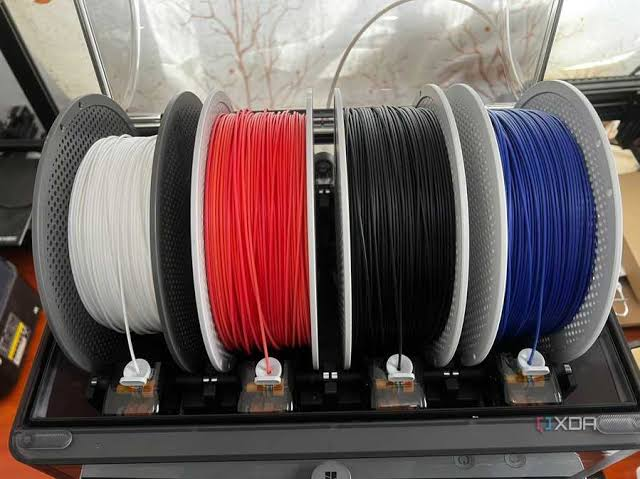
One detail worth flagging for anyone printing multi-colour or display pieces: AMS-style systems that automate filament switching mid-print rely on consistent spool diameter and reliable feed behaviour from every colour loaded. A bargain spool with inconsistent diameter that prints fine on its own can still cause jams or colour-swap failures in a multi-material setup, simply because the tolerance margin is so much tighter when several spools are feeding through the same system.
If you’re moving between materials for the first time, a quick settings reference helps avoid the single most common mistake: trusting a generic PLA profile for PETG, or vice versa. PLA typically prints in the 190–220°C nozzle range with a 50–60°C bed and no enclosure needed. PETG needs a hotter nozzle, around 220–250°C, and benefits from an enclosure on larger prints even though it isn’t strictly required. ABS and ASA both push past 230°C and genuinely need an enclosure to avoid warping and cracking as the part cools unevenly. Carbon-fibre composites such as PLA-CF, ASA-CF, and PA-CF run hotter still and require a hardened nozzle from the very first spool, not just after problems start showing up. Treat your slicer’s default profile as a starting point, not a guarantee, especially the first time you load a new material.
None of this is really about brand loyalty. It’s about the fact that a cheap spool that fails halfway through a six-hour print, wasting both material and time, was never actually the economical choice to begin with. Buying from a source that stores filament correctly — vacuum-sealed, desiccant-packed, dispatched with real shelf life remaining — and matching the material to what you’re actually building solves more print-quality problems than any slicer setting ever will.