
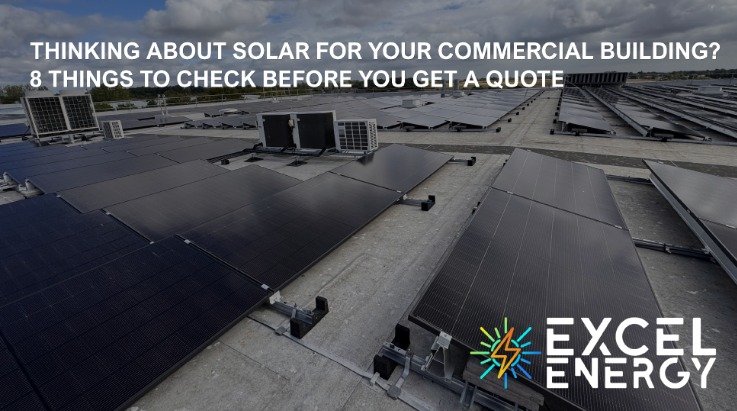
Most conversations about commercial solar start with numbers. How much will it cost, how much will it save, and how long until it pays for itself? Those are fair questions, but the answers depend on a handful of practical things that many businesses don’t look at until an installer turns up with a clipboard.
If you run a factory, warehouse, farm or office in the UK and you’re weighing up solar, it’s worth spending an afternoon on the points below first. You’ll have better conversations with installers, you’ll spot weak quotes more easily, and you’re less likely to hit a delay halfway through the project.
1. How long does your roof have left?
Solar panels are built to last 25 years or more. If your roof needs replacing in eight, you’ll be paying to take the whole system down and put it back up again, which can wipe out a good chunk of the savings.
Ask your facilities team or a roofing contractor for an honest view of the roof’s condition. If it’s getting close to the end of its life, it’s often cheaper overall to do the roofing work first and install solar straight after.
2. What is the roof made of?
Many industrial and agricultural buildings put up before 2000 have fibre cement roof sheets, and some of these contain asbestos. That doesn’t automatically rule out solar, but it changes the approach. You may need an asbestos survey, and depending on the findings, the options range from specialist fixing methods to overcladding or replacing the sheets entirely.
Profiled metal roofs are usually the simplest to work with. Flat roofs with a membrane covering are also very common, though they bring their own questions about fixings and waterproofing.
3. Can the structure take the extra weight?
A typical rail-mounted system on a pitched metal roof adds roughly 12 to 15 kg per square metre. Ballasted systems on flat roofs, which are held down by weight rather than fixed through the roof, can add a good deal more.
A reputable installer will arrange a structural survey before committing to a design. If a quote arrives without any mention of structural checks, ask why.
4. When does your business actually use electricity?
This is the question that has the biggest effect on your return, and it gets overlooked surprisingly often. Solar generates during daylight hours, peaking around midday. Power you use on site is worth far more to you than power you export to the grid, because it replaces electricity you would otherwise buy at full commercial rates.
A business that runs machinery, refrigeration or air conditioning through the working day will usually see a much better payback than one that uses most of its power overnight. Ask your energy supplier for your half-hourly consumption data. Any installer worth talking to will want to see it, and it lets them size the system to your real usage instead of guessing.
If a lot of your demand falls in the early morning or evening, it may be worth asking about battery storage alongside the panels.
5. Will your local network accept the connection?
Anything beyond a very small system needs approval from your Distribution Network Operator (DNO) before it can connect. For most commercial installations this means a G99 application. Response times vary by region, and in some parts of the country the local network is already heavily constrained.
This catches many businesses out. Sometimes the DNO will approve the system but limit how much power you can export, and sometimes it will ask for a contribution towards network upgrades. Neither is necessarily a deal breaker, but you want to know early. Ask any installer you speak to how they plan to handle the application and what they know about capacity in your area.
6. Do you need planning permission?
In England, most rooftop solar on commercial buildings now falls under permitted development, and the old 1 MW limit for non-domestic rooftops was removed in 2023. There are still exceptions. Listed buildings, sites in conservation areas and ground-mounted arrays usually need a closer look, and the rules in Scotland, Wales and Northern Ireland differ.
It’s a quick check with your local planning authority, and it’s far better done at the start than after the scaffolding goes up.
7. Have you spoken to your insurer?
Insurers have become much more interested in rooftop solar in recent years, particularly on large commercial and industrial buildings. Many now refer to the RC62 guidance, which sets out recommendations on fire safety, design, installation and maintenance for commercial systems.
Speak to your insurer before you sign anything. Some will want to see specific design features, inspection schedules or installer credentials, and it’s much easier to build those in from the start than to add them afterwards.
8. How will you pay for it, and what support is available?
There are three common routes:
- Buying outright. This gives you the best long-term return. Limited companies may also be able to claim capital allowances against the cost, which can make a real difference to the first-year figures. Your accountant can confirm what applies to you.
- Asset finance or leasing. This spreads the cost, and in many cases the monthly savings on electricity cover most or all of the repayments.
- A Power Purchase Agreement (PPA). A third party funds and owns the system, and you agree to buy the electricity it produces at a fixed rate, usually below grid prices. There’s no upfront cost, but the savings are smaller and the contracts tend to run for 15 years or more.
Also look into the Smart Export Guarantee (SEG), which pays you for the electricity you send back to the grid. Rates vary a lot between suppliers, so it pays to shop around. For systems up to 50 kW, SEG payments generally require MCS certification, so check that your installer holds it. Local grant schemes appear and close fairly regularly too, so it’s worth checking with your local authority or growth hub.
Choosing who to work with
Once you’ve worked through the points above, you’ll be in a much stronger position to compare installers. Good signs include:
- relevant accreditations such as MCS and NAPIT
- case studies from buildings similar to yours
- a clear explanation of how they’ll handle the DNO application
- an honest view of what the system will save based on your own consumption data
Be wary of anyone who quotes a payback period before they’ve seen your usage figures.
It also helps to ask what happens after installation. Panels need very little attention, but inverters, monitoring and the occasional clean all matter over a 25-year lifespan. An experienced commercial solar installer should be able to walk you through their approach to operations and maintenance, not just the installation itself.
Visit our services page: https://excelenergy.co.uk/commercial-solar-panels/
The bottom line
Commercial solar can be one of the more reliable investments a UK business makes, especially with electricity prices well above where they were a few years ago. The businesses that get the best results are usually the ones that ask the right questions early: about the roof, the grid connection, their own energy use and the paperwork. A bit of groundwork before the first quote tends to save a lot of time and money later on.