When the MHRA licensed oral semaglutide on 11 June 2026, one British online pharmacy reported that its waiting list for the tablet jumped from about 10,000 people to roughly 30,000 inside a week. Three quarters of them had never taken a weight-loss injection.
Nobody seriously doubted there would be an appetite for a GLP-1 you swallow instead of inject. Demand was the easy bit. The harder question, and the one that will probably settle how the Wegovy pill UK launch is judged two years from now, is whether Novo Nordisk can physically make enough of it.
That is not a theoretical worry. Analysts at Citi raised it in a note to clients in early August, describing the route to an uninterrupted global supply of the pill as still undefined and warning that production readiness will matter for keeping the momentum going without creating patchy availability between countries. Anyone who remembers the Wegovy injection shortages of 2023 and 2024 will recognise the shape of that risk.
Demand has already been proven
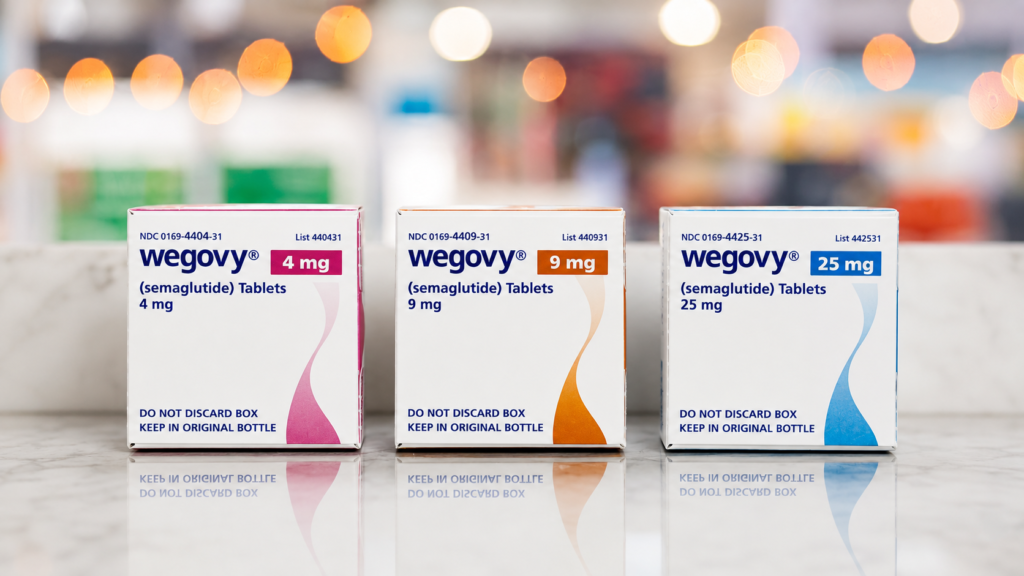
The UK approval covered adults with a BMI of 30 or above and adults with a BMI between 27 and 30 who also have a weight-related condition such as high blood pressure or sleep apnoea. Dosing steps up over several months, starting at 1.5 mg daily and moving through 4 mg and 9 mg before reaching the 25 mg maintenance dose, with at least a month at each level.
The trial evidence behind it, from OASIS 4, put average weight loss at roughly 13.6 per cent of body weight after 64 weeks under the more conservative real-world measure, against about 2.4 per cent on placebo. Among people who stayed on treatment throughout, the figure was nearer 16.6 per cent. That is broadly in line with what the weekly injection achieves, which is precisely why the tablet has drawn the interest it has.
Private prescriptions opened in the UK in July 2026, with pharmacies pricing the starting dose from around £99 a month and the 25 mg maintenance dose closer to £199, depending on the provider and what is bundled into the fee.
The commercial signals from elsewhere are just as strong. Novo said in early August that the pill had reached more than five million patients since its January launch in the United States, with weekly prescriptions there passing 265,000 in the week ending 17 July. In the second quarter of 2026 the tablet contributed around 3.22 billion Danish kroner, close to 500 million dollars, while sales of the injectable version grew only 1 per cent. Novo’s finance chief noted that more than 90 per cent of pill prescriptions are coming from people paying out of their own pocket.
So the product works, people want it, and they are willing to pay. The constraint sits further back in the chain.
A tablet is a much heavier lift than an injection
This is the part that gets lost in coverage of the launch. The pill is not simply the injection in a different wrapper. It is a far more demanding product to manufacture, for two reasons.
The first is arithmetic. The injection delivers 2.4 mg of semaglutide once a week. The tablet delivers 25 mg every day, which works out at 175 mg a week. That is roughly seventy times more active ingredient per patient, per week, for a comparable clinical result.
The second reason explains the first. Semaglutide is a peptide, and peptides are normally destroyed by stomach acid, which is why GLP-1 medicines have historically been injected. Novo got around this using SNAC, an absorption enhancer that shields the molecule and helps a fraction of it cross the stomach lining. Only a small percentage of each dose actually makes it into the bloodstream. The rest is lost. That is also why the tablet has such strict instructions about taking it on an empty stomach with a small sip of water and waiting before eating.
Semaglutide itself is produced by yeast fermentation at Novo’s site in Kalundborg, Denmark, then purified and formulated. Fermentation capacity is slow and expensive to add. You cannot order more of it at short notice, and the volumes required to serve a daily 25 mg tablet across multiple countries are on a different scale entirely from a weekly 2.4 mg injection.
Put simply, every patient who switches from the pen to the pill consumes considerably more of the same scarce ingredient.
What Novo is building, and when it actually arrives
Novo has been open about the need to expand. In March 2026 the company committed €432 million, a little over 500 million dollars, to upgrade and retrofit its tabletting plant at Monksland in Athlone, Ireland. The 45-acre site already employs 260 people, and the project is expected to create up to 500 construction jobs.
The strategic detail worth noting is who Athlone serves. Novo has positioned the Irish site as its hub for markets outside the United States, which includes the UK. Kasper Bødker Mejlvang, who runs manufacturing and product supply at Novo, framed the investment as strengthening the company’s ability to meet current and future demand beyond the US market.
Here is the catch. Construction has begun, but completion is phased from the end of 2027 through 2028.
That leaves a gap of roughly two years between the demand arriving and the capacity built to serve it. The Wegovy pill UK rollout, the German launch scheduled for September, and whatever follows across Europe in the second half of 2026 all have to be supplied from the network Novo already has, not the one it is currently pouring concrete for.
The awkward two years in between
Novo’s leadership has projected confidence. Chief executive Mike Doustdar has talked about going all in on making the medicine available to everyone who needs it as European launches begin.
Confidence is reasonable. Novo has spent heavily on capacity across its network, including the integration of three former Catalent sites and a $4.1 billion facility in North Carolina intended to serve US patients with both formulations. The US launch has run at genuinely unusual volume without a public supply failure.
But the US had a head start, a dedicated domestic supply route, and a single market to serve. What is happening now is different: multiple national launches, each with its own pricing, its own regulatory paperwork, and its own set of patients starting at the bottom of a dose ladder they need to climb without interruption.
That is the specific vulnerability. GLP-1 titration is sequential. A patient who cannot get their next dose strength does not simply pause neatly; they either stall, drop back, or come off treatment altogether. During the injection shortages, the strengths that ran short first were the low starter doses, which meant new patients were locked out while existing ones continued. A repeat of that pattern would hit UK private clinics hardest, because they are the ones onboarding new patients every week.
What a squeeze would look like for UK patients
If supply tightens, the effects would show up in fairly predictable ways.
Prices would spread. The current gap between UK providers already reflects wholesale terms and stock position as much as service quality, and that gap widened noticeably during the 2023 to 2024 crunch. Waiting lists would lengthen, and some clinics would restrict new starts to protect continuity for existing patients. Counterfeit risk would climb, as it did last time, with the MHRA having previously issued warnings about fake semaglutide products.
There is also a competitive cost. The Wegovy pill UK price sits in the same band as the injection, and patients choosing between them are making a convenience decision, not a clinical one. Convenience is a fragile advantage. A tablet you cannot reliably obtain is less convenient than an injection you can.
The competition is not solving the same problem
This is where the manufacturing question becomes a strategic one rather than an operational one.
Eli Lilly’s rival pill, Foundayo, was approved by the FDA on 1 April 2026 and reached the US market that month. Its active ingredient, orforglipron, is a small molecule rather than a peptide. It is made by chemical synthesis, not fermentation. It needs no absorption enhancer, and it can be taken at any time of day without the fasting rules.
Its trial results are somewhat behind semaglutide’s, with around 12.4 per cent average weight loss at 72 weeks at the top dose. On efficacy, Novo is ahead. On manufacturability, Lilly has the structurally easier product, and small molecules are generally cheaper and faster to scale.
Lilly has submitted orforglipron to regulators in more than 40 countries, with a UK decision expected to follow a mid-2026 submission and private availability plausible from late 2026 into 2027. Novo currently holds a real lead in Britain: it is licensed, it is on the market, and its competitor is not. How much that lead is worth depends almost entirely on whether Novo can keep shelves stocked while it lasts.
NHS access sits downstream of all of this
The tablet is private-only in the UK for now. NHS funding requires a separate decision from NICE, which has oral semaglutide for overweight and obesity in its appraisal programme, with timings not yet confirmed. Scotland runs its own process through the Scottish Medicines Consortium.
On past form, NHS access is realistically a 2027 or 2028 conversation at the earliest, and it will be phased. The tirzepatide rollout is the obvious precedent: NICE recommended it, and NHS England then spread implementation over more than a decade, starting with the highest-need patients.
Supply is not incidental to that decision. A phased rollout exists partly because the NHS will not commit to prescribing at a volume the manufacturer cannot underwrite. If Novo can demonstrate dependable European supply by the time the appraisal concludes, a broader and faster rollout becomes easier to argue for. If it cannot, the phasing will be slower and narrower, and the pill stays a private-market product for longer.
What to watch over the next twelve months
A few concrete signals will tell you more than any forecast:
- Whether Novo names specific countries for its next European launches or keeps the language vague. Vagueness usually means capacity is being allocated carefully.
- Whether any dose strength goes into shortage, and which one. Starter doses going first is the classic warning sign.
- Whether UK provider pricing converges or spreads further apart.
- Progress at Athlone against the late 2027 timeline.
- The MHRA decision on orforglipron and how quickly Lilly moves once it lands.
The Wegovy pill has had one of the strongest pharmaceutical launches on record by volume. The science is settled, and the market has answered. What remains genuinely open is an industrial question, and it will be decided in fermentation tanks and tabletting lines rather than in clinical trials.
Frequently asked questions
Is the Wegovy pill available in the UK?
Yes. The MHRA approved oral semaglutide on 11 June 2026, and it became available through private prescription in July 2026. It is not funded by the NHS.
How much does the Wegovy pill cost in the UK?
Private pricing typically starts around £99 a month for the 1.5 mg starting dose and rises with dose, reaching roughly £199 a month at the 25 mg maintenance dose. Prices vary by provider and by what is included in the fee.
Is the Wegovy pill as effective as the injection?
Trial results are broadly comparable. OASIS 4 reported around 13.6 per cent average weight loss at 64 weeks on the conservative measure, against roughly 16.9 per cent for the 2.4 mg weekly injection in its own trial programme. The absorption rules matter, though: taken incorrectly, much less of the dose reaches the bloodstream.
Could there be a shortage of the Wegovy pill in the UK?
It is a real possibility rather than a certainty. Novo has not reported one, but analysts have flagged that the path to uninterrupted global supply is not yet clearly mapped, and the plant expansion intended to serve markets outside the US does not complete until late 2027 into 2028.
Is the Wegovy pill the same as Rybelsus?
No. Both are oral semaglutide made by Novo Nordisk, but Rybelsus is licensed for type 2 diabetes at doses up to 14 mg. The Wegovy pill is separately licensed for weight management at up to 25 mg.
When will the Wegovy pill be available on the NHS?
There is no confirmed date. NICE has to complete its appraisal first, and on past timelines NHS access is unlikely before 2027 at the earliest, most probably as a phased rollout.
Weight-loss medicines are prescription-only and should be used under medical supervision alongside dietary and activity changes. Speak to a GP or a registered prescriber about whether treatment is appropriate for you.
Sources
- European Pharmaceutical Review: Novo Nordisk expands oral GLP-1 manufacturing capacity in Ireland
- Fierce Pharma, Novo CEO has ‘no doubt’ on eventual share price recovery as Wegovy pill continues to wow (5 August 2026)
- Novo Nordisk Q2 2026 results
- Pharmaceutical Technology: Novo Nordisk’s comeback stirs as Wegovy pill wins UK approval
- Endpoints News and Bloomberg, UK waiting list reporting, June 2026
- MHRA product information for semaglutide tablets
- NICE, oral semaglutide for managing overweight and obesity (in development)
- Eli Lilly, FDA approval of Foundayo (orforglipron), April 2026