
Search any app store for numerology and you will get hundreds of results within seconds. Most of them do the same thing: take your birth date, run a short calculation, and return a paragraph of generically flattering text. A small number do considerably more, and the difference between the two categories is not obvious from the screenshots.
This guide is about telling them apart. It is written from the perspective of someone who wants an accurate chart rather than a horoscope-shaped mood boost, and it applies whether you are entirely new to numerology or have been calculating your numbers by hand for years.
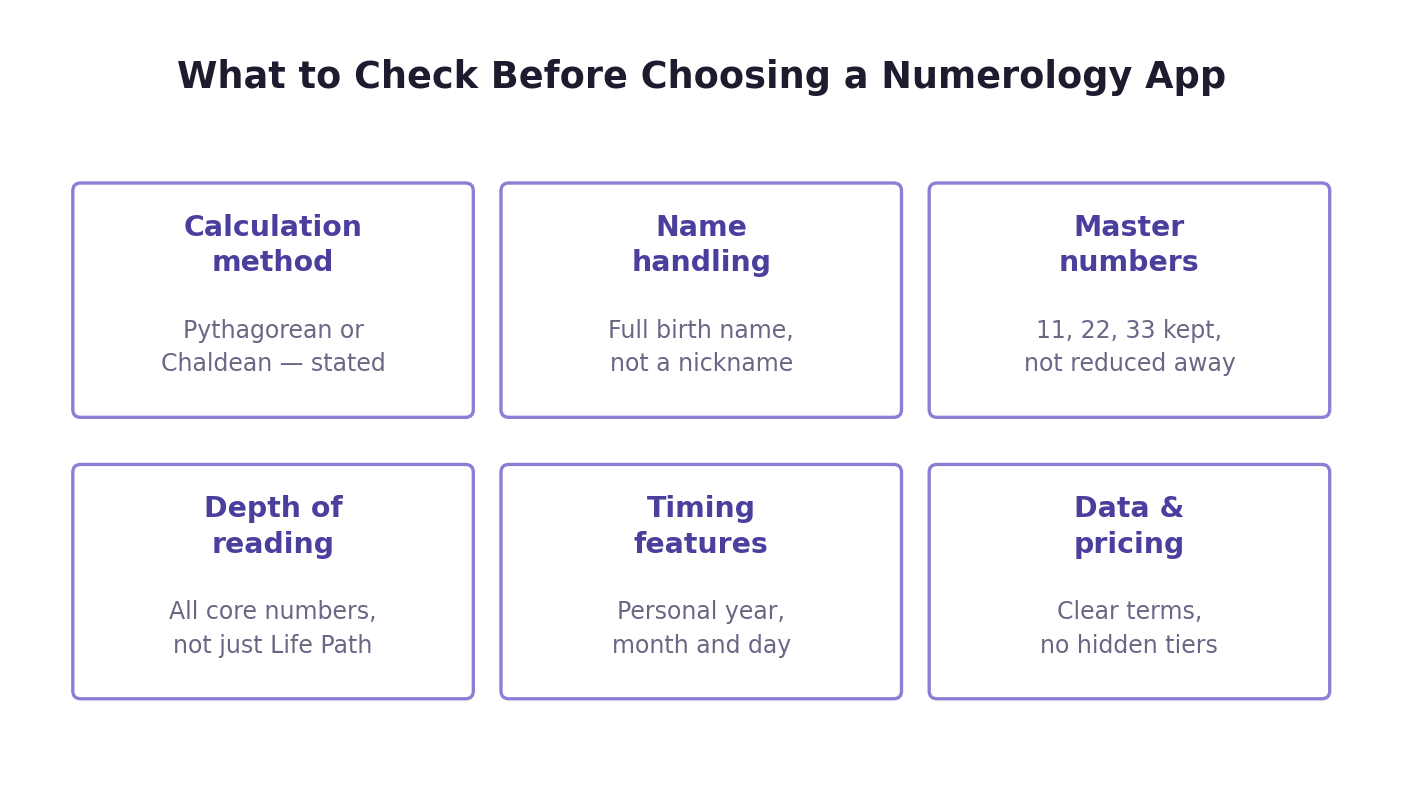
Image: What to check before choosing a numerology app
Start with the calculation system
The first question to ask of any app is which system it uses, and whether it tells you.
The two dominant traditions are Pythagorean and Chaldean. Pythagorean assigns letters to numbers 1 through 9 in simple alphabetical order and is by far the more common in Western practice. Chaldean uses a different letter-to-number mapping, skips the number 9 in its assignments, and derives from an older Near Eastern tradition. Neither is more correct than the other, but they produce different results for the same name, so an app that mixes them or refuses to say which it uses is producing numbers you cannot verify.
A good app states the system on its methodology page or in its settings. An excellent one lets you switch between the two and see how the reading changes. An app that says nothing at all is asking for trust it has not earned.
Check how it handles your name
This is the single most common failure point, and it is worth testing before you commit to anything paid.
Traditional numerology derives the Expression, Soul Urge, and Personality numbers from your full name as recorded at birth — not your married name, not the shortened version everyone actually calls you, not your handle. An app that asks for “your name” without clarifying which one is either being careless or has decided the distinction does not matter.
Test it directly. Enter your full birth name, note the numbers, then enter a nickname and compare. If the app produces the same result for both, it is not doing the calculation. If it produces different results and explains why the birth name is the one that counts, that is a good sign.
Master numbers are a reliable quality signal
In most numerological traditions, 11, 22, and 33 are master numbers and are not reduced to 2, 4, and 6. They carry their own interpretations, generally around intuition, building at scale, and teaching respectively.
A surprising number of apps reduce them anyway, either because the developer implemented a naive digit-sum loop or because the interpretation library did not include them. This is easy to check: if you or someone you know has a Life Path that should resolve to 11, run it and see what comes back. An app that returns 2 has told you something important about how carefully it was built.
The same applies to karmic debt numbers — 13, 14, 16, and 19 — which some traditions flag when they appear before reduction. Their presence is optional; their correct handling, if the app claims to cover them, is not.
Look for depth beyond the Life Path
The Life Path number is the headline, and plenty of apps stop there. A full chart contains considerably more: Expression, Soul Urge, Personality, Birth Day, Maturity, and the Personal Year, Month and Day cycles that govern timing.
There is a practical reason this matters. A Life Path number alone tends to produce readings that feel true of almost anyone, because it describes a broad life orientation. The interesting material — the parts that actually feel specific — usually comes from the interaction between numbers. A Life Path 8 with a Soul Urge 2 is a genuinely different person from a Life Path 8 with a Soul Urge 5, and an app that never surfaces the second number cannot tell you that.
If you are comparing options, a resource like this roundup of the Best Numerology app choices for 2026 is a reasonable starting point for narrowing the field before you install anything.
Timing features separate useful apps from novelty ones
The part of numerology people find most practically useful is cycle work — Personal Year, Personal Month, Personal Day. These change, which means they give you something to check against rather than a fixed description you read once and forget.
An app that calculates only your static numbers has a short useful life. You read it, you agree or disagree, you delete it a week later. An app that tracks cycles gives you a reason to return and, more importantly, gives you a way to test whether the framework tells you anything. Note what your Personal Year predicted in January, read it back in December, and decide for yourself.
The boring but important part: data and pricing
Numerology apps ask for your full birth name and exact date of birth. That combination is a fairly complete identity package, so it is worth two minutes on the privacy policy to see whether that data is shared with advertising partners.
On pricing, watch for the pattern where the app performs the calculation, shows you a teaser, and then requires a subscription to reveal the result you were told was free. Free tiers are fine. Free tiers that are actually a paywall wearing a disguise are a signal about how the rest of the product is built.
How to test any app in five minutes
Run one chart by hand. Take your birth date, reduce day, month and year separately, add them, reduce again — stopping at 11, 22, or 33 if you hit them. Compare that to what the app returns.
If it matches, the arithmetic is sound and you can evaluate the interpretation on its own merits. If it does not, no amount of good design will fix the problem underneath.
Then read the interpretation with one question in mind: could this apply to anybody? Some generality is unavoidable in a system with nine outcomes. But a well-built reading should say at least one thing specific enough that you could disagree with it.
The short version
Check the system, check the name handling, check the master numbers, look for depth beyond the Life Path, and prefer apps that track cycles over apps that hand you a fixed paragraph. Platforms like Raka numerology that publish their method openly are easier to evaluate than ones that hide it, and in a category this crowded, transparency is the most reliable filter you have.