
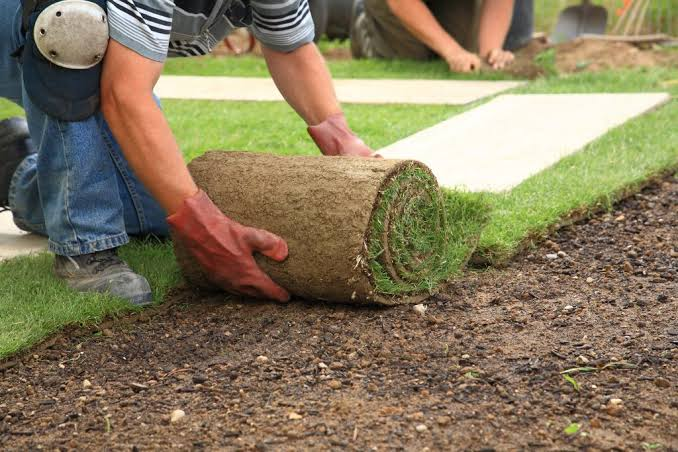
A couple of years ago I read about my neighbor’s 3 year ‘war’ against his very average lawn. Every year he would re-lay the same patch of new turf only for it to die and turn brown by February due to lack of rain. His large sprinkler system would then kick in for 6 days a week in an attempt to save it. It was a constant battle against nature that he couldn’t win. He had a large patch of kikuyu that always looked worse than the rest of the lawn and then there was the massive couch patch. In the end he has since re-turfed the whole lawn with buffalo turf and has not had to touch the sprinkler system in 4 years.
I remember my neighbor’s battle with the lawn. For three years my neighbor spent all summer planting new turf only for it to brown off a few months later. In addition to his failed attempts at growing lawn he also spent thousands setting up a sprinkler system to water the lawn, running it 6 days a week. The only grass type that he found grew well were kikuyu lawns and couch lawns but after reading about the new low maintenance lawn varieties in particular the soft-leaf buffalo lawn varieties he decided to give them a go. And that was 4 years ago.
Step 6: Aussie Climate Isn’t Easy To Grow Lawn In
The climate in Australia is not ideal to grow lawns in many different parts of the country.
Australia is not one climate zone; it is six and they are all trying to happen at once. The coastal regions of Australia’s eastern states are very wet and humid, while the climate of Western Australia is extremely dry. For most backyards, the grass is optimized for somewhere else. Most are grown for more stable climates with consistent rain.
As Australian lawns exist in six different climates and for most Grasses, six conditions create problems that the grass cannot overcome. Buffalo Grass however can grow well in all of these situations and as such is suited for the Australian climate.
The deep root system of buffalo grass is one of its greatest attributes in very hot dry weather as it is able to pull moisture from lower in the soil profile than most other varieties of grass. It will continue to grow in very dry weather when most other lawn varieties will be starting to struggle and go dormant. In times of severe drought and water restrictions it is not uncommon to see other lawn varieties turn to straw like color whilst a well established buffalo lawn will go dormant but recover quickly when the rains return.
Lawn shade performance: the thing buffalo genuinely does better
How many hours of actual direct sunlight does your backyard receive? Not “it seems
How many hours of direct sunlight does your yard get to receive each day? (Not just seem to) Measured in direct unobstructed sunlight hours (not watered down by shade trees etc). Most backyards in Australia have plenty of trees so even established lawns get less than half a day of direct sunlight and that’s important to measure when looking at various lawn types.
Another factor to take into account when selecting a lawn would be the amount of direct sunlight your yard will receive. Measured in direct sunlight hours, not feeling it has to be, there are many trees in backyards around Australia. Established trees in particular create shaded sections of lawn that perform better with some grasses than others.
For example, Couch grass is not capable of growing well in low light conditions and will soon thin out in sections of lawn that receive limited amounts of direct sunlight. Similarly, Kikuyu will grow up towards the light but will quickly begin to thin out if it is not receiving sufficient direct sunlight. On the other hand, Buffalo grass have been specifically bred for use in a variety of light conditions. Many of the new soft-leaf varieties have been developed to perform in lawns receiving as few as three to four hours of direct sunlight per day. This makes them the ideal lawn for yards with many trees, or other structures such as a pergola.
If you are serious about doing your research to find out whether buffalo grass is a good option for your lawn then there are some quality websites where you can read up on the various different lawn cultivars that are available, including information about buffalo grass specifically. One such quality website is http://www.anchorlinkbetturf.com which has plenty of information regarding buffalo grass including information comparing different cultivars of buffalo grass for sale as lawn turf. When purchasing turf at a retail outlet, it is easy to think that there is little difference between apparently identical products.
However, there are differences between the various cultivars of a particular species of lawn grass that are used for commercial production of high quality lawn turf for sale to homeowners and landscape contractors. By learning more about the various species and their various cultivars and their characteristics it will become clear to you about the pros and cons of each for your specific situation, and thus will allow you to make an informed
What is Low Maintenance Lawn?
As for the issue of maintenance, few people will realistically be able to declare that they have a 0 maintenance policy when it comes to their lawn, be it made up of buffalo grass or otherwise. In our experience however the majority of grass species need to be mowed, watered, fertilized and aerated on a regular basis. Buffalo turf is different in that it does not need to be maintained as frequently as the majority of other grass varieties, in fact it can be left to grow for extended periods of time as it is very easy to maintain.
To paint a clearer picture here of the different sorts of lawn maintenance you will require to look after different varieties of grass, I have detailed them below:
| Grass type | Mowing frequency (summer) | Watering needs | Shade tolerance |
| Buffalo (soft-leaf) | Every 2-3 weeks | Low to moderate | Good |
| Couch | Weekly or more | Moderate to high | Poor |
| Kikuyu | Weekly | Moderate | Poor to moderate |
| Zoysia | Every 2-3 weeks | Low | Moderate |
There is also a point that I made earlier in relation to the merits of buffalo grass that needs to be addressed in more detail, and that is to the fact that buffalo grass has a thick layer of thatch, or dead grass, at the base of each blade of grass. This thatch can sometimes be a problem, in that it can become so dense that it can block water and air from reaching the grass roots.
The removal of such large amounts of thatch from lawns is referred to as dethatching, and is typically required annually for such lawns. It is a very difficult job to undertake, and typically requires the use of very hard spiked tools that are dragged over the lawn to pull out the thatch. It is not typically something that homeowners would want to attempt themselves, but in terms of the problems that it causes to lawns, it is certainly a problem for some grasses more than others. And while some retailers of buffalo grass may fail to mention this in the fine print, it is a problem for some lawns with this type of grass. But it is not a problem for lawns without thatch, so there is no need for homeowners to worry about it if they do not have it.
Why it keeps winning
Most lawn turf developments have a life span of no more than a few years. New varieties of lawn turf are constantly being developed and released to the public at horticultural trade shows. For a short period of time these new lawn grasses receive lots of press and suddenly can be found in every nursery in the country. Most of these new lawn varieties are not really that different from existing turf grasses but some have made great improvements through the process of selective breeding over the last twenty odd years. The soft-leaf Buffalo grass is one of the grasses that has really stood the test of time and addresses the needs of most home owners with lawns. Homeowners interested in emerging technology and innovation can also appreciate how advances in turf breeding and water-efficient lawn development continue to improve modern landscaping solutions.
- Summer heat that would crisp a lesser lawn within weeks
- Shaded backyards that eliminate most of the competition before it even establishes
- A lifestyle reality where most people genuinely cannot spend every weekend on lawn maintenance
- Water restrictions that make high-demand varieties increasingly impractical, and increasingly expensive
Returning to my example of my neighbor and his long lost lawn battle, he is not a fanatic. He is not obsessed with the lawn. In reality he doesn’t really have the time to be messing around with a lawn. What he wanted was a nice lawn. He wanted to have an outdoor space that he could use. I didn’t tell you this before but he left it to grow. It did just fine.
So for the average back yard in Australia this is what you are looking for in a lawn.