
The landscape of UK higher education is shifting. For decades, the gold standard of academic success was the written word. If you could craft a perfectly cited, logically sound 3,000-word essay, you were set. But walk into any lecture hall at a top-tier university today, and you will notice a change. Tutors are no longer just looking for “book smarts”; they are looking for “stage smarts.” The modern undergraduate is expected to be a polymath—someone who can research like a scholar and present like a TED Talk professional.
This evolution hasn’t happened in a vacuum. Employers in the UK’s competitive graduate market are demanding more than just a degree certificate. They want candidates who can communicate complex ideas to stakeholders, lead meetings, and influence people through speech. Consequently, universities have integrated oral assessments into almost every module. Whether you are studying Nursing, Engineering, or Law, the pressure to maintain written excellence while meeting high public speaking demands has created a unique set of hurdles. For many navigating this workload, finding reliable assignment help the UK through platforms like Myassignmenthelp has become a common strategy to keep their written grades high while they dedicate time to practicing their vocal delivery.
The Evolution of the “Vocal” Assessment
Historically, oral exams were reserved for language students or those defending a PhD. Today, however, “authentic assessment” is the buzzword in UK universities. This means tasks that mimic real-world scenarios. Instead of a written report, a business student might be asked to pitch a product. A science student might need to present a poster at a mock conference.
The difficulty lies in the fact that writing and speaking use two different parts of the brain. Writing allows for reflection, editing, and the luxury of time. Public speaking is immediate; it is about body language, tone, and the ability to read a room. When these two requirements collide in a single semester, the mental fatigue can be significant. Students often find themselves trapped in a cycle of “all-nighters” to finish a paper, only to have to stand in front of a class the next morning to explain it.
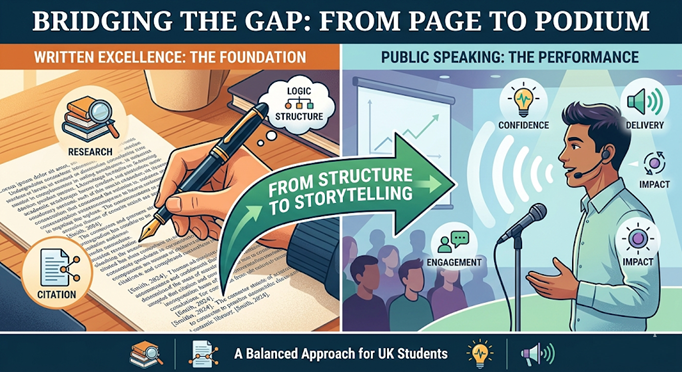
Bridging the Gap: From Page to Podium
The most successful students are those who treat their written assignments as the “script” for their verbal presentations. There is a deep synergy between the two. A well-structured essay provides the logical skeleton for a speech. If your arguments are weak on paper, they will crumble the moment you open your mouth in a seminar.
One area where students frequently struggle is spontaneous communication. While a prepared presentation is one thing, being asked to deliver a coherent extemporaneous speech on the fly is another. Many find that Myassignmenthelp resources on this specific topic offer the best roadmap for organizing thoughts under pressure. Mastering this skill is often the difference between a 2:1 and a First-Class mark in modern seminars, as it demonstrates that you truly understand the material rather than just memorizing a script.
Comparison: Written Assignments vs. Oral Presentations
| Feature | Written Assignments (Essays/Reports) | Oral Presentations (Speeches/Vivas) |
| Primary Focus | Depth of research and citation accuracy. | Clarity of message and audience engagement. |
| Preparation | Long-term drafting and editing. | Rehearsal, timing, and visual aid design. |
| Feedback Loop | Delayed (tutor comments weeks later). | Immediate (questions from the audience). |
| Key Skill | Academic tone and technical vocabulary. | Confidence, pace, and non-verbal cues. |
| Pressure Point | Meeting word counts and deadlines. | Managing “stage fright” and spontaneity. |
Why Public Speaking is No Longer “Optional”
In the UK, the Office for Students (OfS) and various university boards have emphasized “employability skills.” This is why you see a rise in group projects and presentations. If you are an undergraduate today, you are likely part of the most assessed generation in history. The goal is to ensure that when you graduate, you don’t just know the theory of your subject, but you can also argue for its importance in a boardroom.
However, this creates a “double burden.” A student might be a brilliant writer but suffer from social anxiety, or they might be a natural orator who struggles with the rigors of referencing and academic structure. Balancing these requires a high level of emotional intelligence and time management. It is not just about doing the work; it is about shifting your persona from a quiet researcher to a confident communicator multiple times a week.
Practical Tips for the Modern Undergraduate
To survive this dual-demand environment, you need a system. Here is how to keep both plates spinning:
- Reverse Engineer Your Speech: Start with your essay research. Summarize your 2,000-word paper into five key bullet points. If you can’t explain your essay in two minutes, you don’t understand it well enough yet.
- Record Your Rehearsals: Use your phone to record yourself speaking. It feels awkward at first, but you will notice filler words (like “um” and “uh”) that you can then eliminate.
- The “Power Hour” Method: Dedicate specific blocks of time to writing and separate blocks to speaking practice. Trying to do both at once leads to “context switching,” which drains your energy.
- Seek Technical Support: Don’t be afraid to use academic tools. Whether it is a citation generator for your bibliography or expert advice on speech structure, using available resources shows maturity, not weakness.
The Role of Academic Support Services
As the bar for “excellence” continues to rise, many UK students are looking for ways to optimize their study time. The rise in academic support services isn’t just about getting someone to help with a difficult topic; it’s about strategic delegation. By getting guidance on the structural components of an essay, a student can free up the 10 hours they need to properly rehearse a high-stakes presentation. This holistic approach to education—knowing when to work hard and when to work smart—is a hallmark of the modern student experience.
Final Thoughts on Academic Harmony
Balancing the pen and the microphone is the ultimate test of a contemporary degree. While it feels overwhelming, these are the skills that will define your career. A student who can write a brilliant report and then stand up and defend it with poise is unstoppable. Remember, written excellence gives you the authority to speak, and public speaking gives your writing a voice. Embrace both, and you won’t just pass your modules—you will master your field.
Frequently Asked Questions (FAQ)
1. How do I turn a technical essay into an engaging presentation?
Ans: Focus on the “Why” rather than just the “How.” Your essay handles the data, but your speech should handle the story. Use visual aids like charts or simple diagrams to replace long paragraphs of text.
2. What is the most common mistake UK students make in oral exams?
Ans: Reading directly from their slides or notes. Tutors want to see eye contact and engagement. Your notes should be brief prompts, not a full script.
3. Is it okay to use professional help for my UK assignments?
Ans: Yes, seeking academic support is a standard practice for many students who want to clarify complex topics, improve their writing style, or manage a heavy workload more effectively. It’s about using every tool at your disposal to achieve the best possible grade.
4. How can I get better at spontaneous speaking?
Ans: Practice “table topics” or short, unplanned talks on random subjects. The more you practice structuring a quick response (Introduction, Body, Conclusion), the more natural it will feel during a seminar.
5. How much of my grade usually depends on speaking?
Ans: In many UK undergraduate courses, oral components can now account for 20% to 50% of a module’s total mark, making it just as important as the final exam or essay.
About The Author
I’m Lucy Wilson, an academic consultant and content strategist at Myassignmenthelp, where I specialize in helping UK students navigate the complexities of higher education. With a background in academic research and a passion for student wellness, I focus on bridging the gap between theoretical knowledge and practical communication skills.